Jun 27, 2009

In My Beautiful Balloon...


I tend to avoid standard reviewing of contemporary animated films. In the first place there's plenty of that everywhere else. And more importantly I feel close enough to even those films and studios I personally have nothing to do with that I'm sure my reactions are skewed one way or another. There's aren't degrees of separation, plural, in the animation business. We're virtually all connected with every kind of tie and association, sometimes unwittingly. So it can get complicated. In any case I thought I'd post some random thoughts I had while watching "Up" in 3D a week after its opening:

I was struck by how beautiful I found the palette and textures to be. It looked painterly, roughly so in places, as with the side of a palette knife. There was a particularly delicate use of lighting in what seemed a great collaboration of the visdev(AD) and CG departments. It made such an impression on me that I I broke one of my cardinal rules and elbowed the person next to me, forcing him to lean in so I could hiss "I can't believe how great that lighting is!" and "Would you look at that fireplace!" in their ear. What you wish for as a toiler and as an audience member is that the story and visual beauty will both take you out of yourself and put you in that world, and I thought the entire opening succeeded brilliantly with it. I may sound as if I'm contradicting myself there, but it was a beat after being impacted by the beauty of the shot that I woke up to the extraordinary aspect of it. Eating one's cake and seeing it, too. The sets looked to me for all the world like a cozy Viewmaster setting from the early 60s, which I delighted in throughout.


I admired (as so many did) the storyboarding, particularly the "growing older together" montage early on. I reckoned it was done by head of story Ronnie del Carmen, and someone told me I was right.
There are a lot of ways to board anything, never one right way (the filmmakers hope it seems the only way), but the way that was done--the transitions, cuts, all the choices--were perfect. I arrived at that verdict because I felt exhilarated watching it. It had to be a tightrope walk to avoid slipping into bathos (some critics felt it did slip, but only a few; to achieve that is a feat with this material).

I felt as touched by the sweet comedy relief of Dug the dog as I did at Carl's running struggle with loss. That might seem a pretty odd thing to say-and I allude here with a virtual smile to my respected friend who may think I've regressed to an eight-year-old's perspective to claim it-but there it is.

"Dug" was a win for me because of this: one of my pet peeves is the lack of films that make use of plain old reality for comedy, for pathos, for appeal. Dug was in appearance a wildly caricatured canine, but his actions, movement and the clever way his thoughts were translated into dialogue were more real than real for any dog lovers in the audience--and judging from my audience there were a lot of us. The kids squeal and love him because he's friendly-looking, and funny. The adults laugh and respond because they consciously recognize Dogs They Have Known in this unlikely character--and here, by the way, is an illustration of the work methods of the filmmakers I was blogging about in an earlier post. I don't know which of those involved drove the character's handling-director, story people, producers,animators or as is likely a melange of all of them. But those people know dogs, and moreover have loved dogs--a special dog. And have a healthy amount of empathy and imagination and skill enough to make their experience translate to the screen. This is why I enjoyed Dug so much, and not because I'm wallowing in my childhood.

And this gives me an opportunity to say how really fine I thought the character animation was in "Up". I don't know who you are, but I want to find out-all of you: the crews who did Carl (young Carl and Ellie in particular-superb), Dug, Muntz, "Kevin"...all these characters had scenes where the movement and performance blended together in an idiosyncratic and beautiful way. It's a new high point for you guys-as every new film should be, ideally.

There were issues that I found myself thinking about while the film was running, things that I didn't understand, or that I would have done differently. It's a habitual story habit thing--an occupational hazard of the business. I could go into them but I won't, not even obliquely. Not because they're so harsh that I'm afraid to offend but because--on my blog or off--I'm wary of being taken out of context and let's face it, it does happen. It's all too easy to misread a written sentence. It's too black and white, and where some things are concerned my opinions and reactions are more fluid than that. I'm much more comfortable discussing anything I take issue with in person, where a conversation can be had rather than a one-sided speech made. And I'm not a professional critic besides.

An old man in a flying house heading for South America is not your everyday plot. Add a lot of visual beauty and some sincere heart and I want to see it. More than once.

Jun 15, 2009

Artist Beware


Melinda Beck is nobody's fool; she's also successful and experienced enough to turn down an offer from Google to do work for them for free. Photo by Ruby Washington for The New York Times.

This article in the New York Times caught my eye today.
There's been a lot of this going around lately involving artists-most of you have heard or read about the "exposure opportunity" giveaway/contest deals various large businesses have been baiting animation artists with. Here's more of the same nonsense, this time from Google. I recommend reading it. Warning: your blood will likely boil.

"Use Their Work Free? Some Artists Say No to Google"

ADDENDUM: Via Drawger-an illustrator's internet destination site-there's a page of feedback reaction to this article, some of it from artists quoted in the Times piece, all of it well articulated. Read it here.

Jun 13, 2009

Ward had a hell of a nerve


click to enlarge

Over at the union blog Steve Hulett posted a link to a Life magazine photo archive that deals with Walt Disney. Lots of interesting shots there, not all just of Walt. But I really love the one above. I've seen others from this same session but I can't recall ever before noticing that killer caricature of The Boss smack dab in the middle of it, pinned prominently next to Ward's desk. What an expression.

It looks like there's one of Walt Kelly's "Ward's life" gag drawings hanging from the shelf under the lamp, too. You know, one of these days someone's going to do a book...

Jun 11, 2009

Pix[ar] is [not just] for kids.


"If you want to make a movie for children then make a movie for children. The experience for a parent or guardian is that they are spending time with their children at their child's level. The movie is not meant to satisfy an adult in the audience. You do not have to consider adults when creating content or story lines for "childrens" movies. Far to often mature content is blended into scripts only to promote the feature as "something for all to see". The marketing of this movie was selfishly aimed at drawing young children to the theatre. You call it "PG" but then you market it for a younger audience. Creating many 6, 7, 8 ,9 and 10 yr old Birthday parties/gatherings when this content is way too deep for them to handle and or enjoy. Pixar...Step back and really think about what you product is saying and who will be watching and effected by it. Two thumbs down from Daughter and Dad."
— ke flannigan, boston

-from the New York Times readers' responses to Manohla Dargis' review of "Up"

I finally saw "Up" last weekend, and I mean to write some of my first impressions in a future post. I'd avoided most of the reviews, wanting to see the film with as little baggage as possible, so I had to go back to see what was said about it including its review in the New York Times. Ms. Dargis' take was mostly positive, I think-albeit with some slightly schizophrenic and vague caveats. Her piece seemed possibly edited down.

What really caught my eye was the "Reader's Review" that I quoted above--a comment posted underneath the online version of Ms. Dargis' review. I thought it would be a good springboard for writing a bit about "Up" in particular and all animated films more generally.

So about the comment of "ke": what he writes is simply wrong.

Now, I'm of the opinion that very few if any reactions to a film are ever wrong. How could they be? All artistic experiences are subjective; one person's honest impression is as valid as another's, really, as far as it goes.

Obviously there are plenty of riders on that subjectivity: one person simply might have what I'd call better taste (more subjectivity at work there): they might be more educated about films, more experienced in life, awake, more receptive, generally appreciative of art and/or craftsmanship in all its forms(this can lead to a negative as well as a positive reaction, by the way). Another might have life experiences that drastically affect his or her judgement of a film, whether it's "The Sorrow and the Pity" they're watching or "Duck Soup".

All this might seem obvious, but I've read reviews from professionals that I admire-Andrew Sarris, Pauline Kael, et al-where once in a while they seem-to me at least-to be oblivious to some pretty extreme personal biases. But the bottom line whether professional or paying audience member is that each is entitled to their own opinion--it's the nature of the art.

In the comment above "ke" is taking another tack entirely. He's dead certain that the filmmakers of "Up" have made a cardinal error by misunderstanding who their audience is--children. He's actually dead wrong. Because children as some separate group are not who the film was made for. Certainly it was hoped they'd be part of the audience. Absolutely the reactions of children mattered to the crew, whether they happen to be parents themselves or not.
But so do the reactions of the dads in the audience--and the moms, teenagers, older people, and any other permutation. All of them make up the imagined audience. Yet even then, without forgetting or dismissing them, they aren't who the films are made for, it's who they are shown to--hopefully with the result of entertainment.

I'm going out on a bit of a limb here because I don't work at Pixar, I haven't spoken to the people who worked on this about it, and to date I haven't read any interviews specifically about its production. But I'm still sure I'm right.

"Up" was made for the same people it was made by. That isn't accusing the artists of solipsism-the inability to look beyond one's nose. It's about telling a story with a with a personal meaning, a personal intent. When you start with that, you-and eventually your coworkers-are the litmus test for whether your idea communicates. You know what you want to do, and then you proceed to do your best--everyone pitching in--to accomplish it.

Contrary to some reports Pixar's method isn't really a special secret, magic trick or rocket science. It also isn't easy. I'm sure sometimes it doesn't turn out films exactly as originally imagined. But it stems from individual imaginations: someone with an idea they're totally committed to doing. Other artists are brought on immediately to work on it if it's a go; they too put their stamp, their spin, their characters and their ideas into the mix. The film story usually begins to change, veering one way, then the other. There are peaks and valleys aplenty in the long years of production. There always are. I haven't read of any animated feature production anywhere that was entirely smooth sailing in the story process (well, maybe "Gulliver's Travels" at Fleischer's in 1938-enough said). So with all that work involved over a period of years, there has to be, hopefully, someone at the helm who knows what they want and why it should be there. To say a film is aimed "at children' is too vague, broad and vast a goal. But to please the child, young adult and grownup that the director has inside him or her is not only doable, it's imperative. Certainly the head of a production seeks out other eyes and ears and opinions, but the buck has to to stop somewhere and someone needs to know what the point of it all is.

It's long been a monkey on the backs of both animation lovers and professionals that "cartoons" have been so firmly fixed in many people's minds as primarily directed at children--often, small children. With every non-kid animation watershed in our generation--Roger Rabbit, Ren & Stimpy, The Simpsons, Beauty and the Beast, Shrek, anything produced by Tim Burton, anything written and directed by Brad Bird--it's been hoped that the old cliches about "animation is really the domain of wee ones" would finally be busted wide open--or at least dropped by the critics who really should know better by now.

But weirdly, with all those successes and very un-totlike films' releases--even with a studio or two whose entire output is well-known and successful for more adult oriented comedies--it still hasn't happened, and each time a film is released there are always too many writers who scratch their heads about why on earth something not specifically focused on preschoolers found its way into an animated film.

They forgot, if they ever knew, that even the very first, most famous commercial animated feature had adult thrills, action, and moments of beauty that were aimed at everyone: the grand premiere of "Snow White" had virtually no children present at all (exceptions being perhaps Shirley Temple, or Wallace Beery or Eddie Cantor taking a daughter). No, the stamping, shrieking, laughing and applauding audience was made up of all of the adult producers, directors and actors of Hollywood--everyone from Zanuck to Dietrich. A film made by adults, for adults-and for everyone else who could enjoy it, whatever their age. Why has this been so completely forgotten? Why is it a forgetting that recurs over and over again?

The agenda or template "ke" thinks Pixar should be following is a harrowing one. I've read enough to know that not everyone in animation fandom is pleased with "Up", but I can't believe that anyone, no matter what their take, would believe the answer is Pixar gearing their features for small children.

Why is this father so annoyed that the filmmakers of "Up"--a fable about an elderly man at the end of his life that includes a little boy but has much more, plainly, to do with the elderly man--didn't aim it at a "child's level" in any case? Which world does his daughter live in? Does it have old people and adults in it? Has his little girl ever felt sorry for someone(or herself), or had any sort of loss--even if it was only, say, a balloon she let go of? Does she like to play pretend? Does she like animals and stories?

If the answer to any of those questions is "yes" than she's got a lot in common with the filmmakers, and she's just as much a part of the potential audience as "ke".

Or "jl" for that matter.

May 18, 2009

Ricky, Pete, George Booth and UP


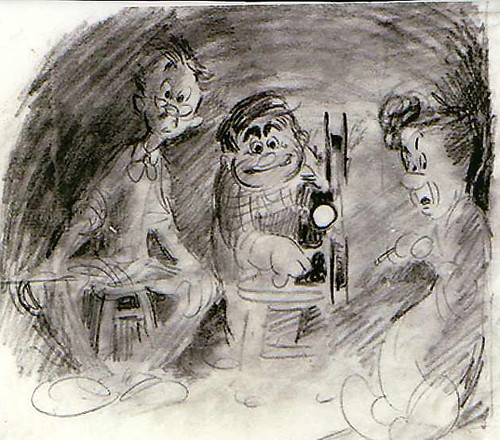
sketch of Carl by Pete Docter

Yesterday's New York Times had an interesting article about the character designs in "UP".

Read it here.

Accompanying the text of the original published piece is yet another of those online-only great Times interactive specialties, with Ricky(Nierva) and Pete (Docter) discussing their ideas. Wonderful stuff.

And if you're not familiar with George Booth yet, you should be.

ADDENDUM: Some of you probably know that "UP" had its premiere at Cannes last week. I know virtually nothing about the film. First, because in its early days as with all the projects of that studio no one working on it or around it said anything, and so pretty much everyone not in Emeryville was in the dark.

When we down south do get jots of information--that Brad Bird has taken over direction of "Ratatouille", for instance--all we know is it's something concerning a rat/chef. Dubious as it might seem as a premise, it's usually a safe bet to assume that Bird will pull off whatever he's doing.

The same goes for the people working on "UP". While I've certainly been curious about it, as its release nears I find I don't want any spoilers at all. I really want to be surprised.

So, the film finally opened at Cannes--the first film screened (out of competition), a gala event. It was reported that it received an ovation. Todd McCarthy, longtime primary reviewer for variety and one of my favorite writers on fllm, filed his report. I skimmed the traditional bold-type opening paragraph, reading no further than that as I didn't want to learn anything crucial. Here's a bit of what he wrote:
Tale of an unlikely journey to uncharted geographic and emotional territory by an old codger and a young explorer could easily have been cloying, but instead proves disarming in its deep reserves of narrative imagination and surprise, as well as its poignant thematic balance of dreams deferred and dreams fulfilled.

Mr. McCarthy doesn't toss around that kind of sentiment very lightly.
It sounds lovely, and I wish the crew all the happiness that a good film will bring, that they've earned through their hard work these last 3-plus years.

May 6, 2009

Kahl Conversation


A short time ago the motion picture Academy had a tribute to Milt Kahl that sounds like it was quite an evening--if you managed to get in (many ticket holders didn't, due to a snafu of some sort).

I wasn't there, unfortunately, but the ensuing mention of it on Michael Barrier's blog and the comments that followed are well worth reading, even though I find I don't entirely agree with anyone's opinions. But that's what makes a horse race. I only just discovered it and suggest you have a read here.

The screen cap above is from a scene near and dear to me and the friend I first watched it with back in the early 80s: the brilliant animator captured in the act of drawing. Talk about intensity.

We watched this episode of the "Disney Family Album" series on Kahl with a lot of awe and a wee bit of fear. Actually, the shots of Kahl relaxing outdoors somewhere up in the beautiful Bay area sunshine were charming, but nonetheless there seemed some undercurrent of coiled tension, of his just barely tolerating the process of being interviewed. Having also heard once-in-a-lifetime stories about working with Milt from his colleague Dale Oliver involving the breaking of Bakelite and other forms of studio equipment might have colored our view. Imagine handing this man some cleanups!

But make no mistake: we were in total thrall to the man's artistic skill. I would have "suffered" working around him gladly for the experience-and it was clear that Oliver and others had relished it and wouldn't have traded it for anything. Such is the spell of genius. I'll bet it didn't hurt that he also appeared to have had a terrific sense of humor. Here's to "Miltie-pie".

Oh, Miltie-pie, if I should die,
Please bury me in 3C-12.

Then I'll know why, but never cry,
About the pictures that they shelve.

I'll gaze upon, what's going on,
And get it straight from Walt—

And then I'll see who's blaming me,
When it is not my fault!

I'll get firsthand, the things they've planned
That animators never know.

See color shots, hear story plots,
Gee, I can hardly wait to go.

Yes, I like Forest Lawn, but when I'm gone,
You know where I'd rather be. . . .

I don't mean heaven, or 3C-11,
It's 3C-12 for me.

-attributed to Milt Kahl & Frank Thomas

Walt Stanchfield Lives


It would be a safe bet that anyone working in the american feature animation industry has either known, heard of or seen the influence and artwork of the late, great Walt Stanchfield.

Stanchfield was a longtime animator at the Disney's from the postwar era through his retirement in the 1980s, but what made him famous beyond the walls of the studio were his handouts-his notes from the classes he taught in gesture drawing. Using a model in quick poses, the task was to capture the essence of an idea-to distill as economicallly as possible all the life, weight, and story the observer could find in the pose.


I really can't say much about Stanchfield that an old friend and student of his couldn't say much better: Dave Pimentel. Dave was an avid student of Walt's and took his lessons seriously-retaining enough to teach the "Stanchfield way" himself in recent years. I'd seen some of the notes and had the odd mishmash of 100th generation xerox copies passed on to me over the years, but sitting and doing it was something else again. There's no substitute for drawing, drawing, drawing, and the enthusiasm of a true believer like Dave really revs up the motor.

As you can see from Dave's post, the notes from his legendary drawing classes have been compiled into book form in two new volumes edited by Don Hahn. These are an absolute must for any artist-forget about their importance as "animation only"; there's gold there for anyone. Frankly, for someone who simply thinks idly of drawing for their own pleasure but no clue how to go about it, I'd point them to these books-but the contents are also bedrock for the most serious draughtsman. As Dave points out, this guru of the pen was also full of life lessons. He must have been an incredible person to know. I wish I'd been able to meet him as well as take his classes, but at least there's a benefit of these new books. A lot of thanks are due to Don Hahn for getting them into print.

Apr 23, 2009

A Matter Of Life And Death - Opening Sequence

RIP Jack Cardiff


A great artist has died: Jack Cardiff was 94, a cinematographer of genius and a notable director. Perhaps the most brilliant "painter of light" with Technicolor that the movies have had--I certainly would given him that title without any hesitation. He worked with Hitchcock, Olivier, and John Huston("The African Queen") to name a few highlights, but for me it was his collaboration on the films of Michael Powell and Emeric Pressburger, "The Archers", that seals it.

Kim Hunter in the opening minutes of "A Matter of Life and Death", one of my favorite films. It was the first Powell & Pressburger film I saw, and its color took my breath away. Id never seen anything like it before.

Obviously this isn't about "animation", but animation is filmmaking, and this is filmmaking of the highest standard-and also, the most imaginative and artistic. Thankfully not "artistic" in the usual way it's used for film-something noncommercial, or worse, dull-but in the very same sense as it's applied to the best of animation. I've always felt that animation has as much to teach live action film as the other way round, and I've been pleased to find that some of the top talents in live action today agree. Yet so much of what could be done with design, color and every other aspect of assembling a film shot by shot, scene by scene seems to make no use of the extra-ordinary applications that animation can produce so brilliantly.

In Jack Cardiff live action had a man who thought out of the box, and the results are obvious. Each of the shots reproduced here is a screen capture from his films. I could and should add more, but these are what I found from some of the DVD review sites on the net. One of those has a terrific review of AMOLAD, great reading for anyone, which is here. If it doesn't make you want to see it, nothing will. I've seen it myself several times with an audience(Martin Scorcese, a huge P&P fan, was responsible for its rerelease some years ago), and it's a wonderful experience, but it's on DVD as well. However you watch any of these films, turn off the phone, sit yourself down and don't do anything but give them your full attention for their running time. I'm sure it will take only the first few minutes to see why..


from "Black Narcissus", another masterpiece

So here's to the life work of a very important figure in our shared industry-film. Hail and farewell, Jack Cardiff.

Mar 21, 2009

Bob Winquist, Design Student


[guest]Design instructor: Tom Pope. Assignment: "Basketball hoop with attitude". Student: Bob Winquist. click to enlarge


Tom Pope was a year or two behind my class at Calarts, and it was great to see him at the get together for Bob Winquist in January. He'd brought with him an amazing rarity with a great story attached that he shared with all of us in his remarks to the crowd. I asked him if he'd share the artwork and its backstory here, and he kindly agreed. With the help of fellow classmate Zac Moncrief the very large framed piece was scanned so it could appear here. Tom's story follows below:

"I was fortunate enough to be a design student of Bob Winquist's for two-and-a-half years. So many people have shared so much about the pleasures and recieved wisdom gained from Bob that there is little new which I can offer. That said, Bob did give me something that not all his students can claim.

One day in Bob's class, winter of '90, I was offering my usual sea of valuable insight. At the end of class, Bob asked me if I wanted to teach the next week. I said sure, but... if I gave an assignment, would he do it?

Of course he would. So I thought of something random, as he oftened appeared to do. "A basketball hoop with attitude." I couldn't wait until the next week!
A week later, projects were pinned on the wall of the class room. It being second semester, there were less people in class and less projects since most people were knee-deep in their films by then. But Bob's assignment was right there among the others as promised. It was beautiful, but I hope I talked about someone else's first. I did my best to talk about and critique each assignment constructively and focus on their distinct merits as Bob always, always, always did.

After class, I asked Bob if I could keep his assignment, and he said of course. He signed it "Bob Winquist, 2/27/90" with a flourish on the back. I had it framed, and it has hung on the wall no matter where I've lived ever since. (I also have a handful of the other assignments in my parents' attic in Georgia.)

When I heard that there was going to be a remembrance for Bob I knew that I had to bring the piece. When I heard that we would be allowed to speak, I knew I had to talk about it. The response it got made me realize how lucky I was to possess an example of Bob's generosity in concrete form. The best part of all was the interest that Bob's own family showed in it. If I hadn't been aware of just how special Bob's own handiwork was, I was then.
Jenny has been generous enough to share this forum and to allow me to share this "wonderful", wonderful piece with a wider audience.
"

My pleasure, Tom. Thank you.

Mar 6, 2009

Walt Disney, Railroader


From the collection of veteran Disney story artist and comics guy Don Dougherty come these terrific shots of Walt enjoying his obsession, apparently taken at the studio. As to who's who and exactly what year these were shot, I'm open to suggestions.
EDITED TO ADD: A commenter named Steve offered this great extrapolation on the photos:

"The top and bottom photos, as I recall (don't have my Broggie book in front of me) was taken in December 1949 during the Lilly Belle's first steam up. That's Eddie Sargent standing between Walt and Roger. He did the drawings for the Lilly Belle.

The British engine with Walt in the middle was never run at Carolwood--it was damaged as it was being shipped over from England. However, you may want to note that when Walt was in the store buying that engine, another gentleman was trying to buy it as well. His name was Harper Goff. He didn't get the engine, but he did get a job at the Disney studios.


Must be clicked to see them better. Thanks for sharing, Don[and Steve]!

Mar 3, 2009

Mary Blair's Alice Redux


From the Cowan Collection

Bob Cowan (he of the incredible collection of animation art) was kind enough to share this with me, and allow me to post it for you.
I really love this painting. Click to enlarge it.

Feb 26, 2009

iPhone App'imation: Randy Cartwright writes an Animation timing app for Apple.

Randy Cartwright: animator, story guy, committed iPhone geek. My kind of fellow. With a self-taught ability to program, this veteran Disney artist has created a neat little application for lucky owners of Apple iPhones and Touchs: an animation timing program called(aptly enough) Animation Timer.


Randy taps the Timer

It wasn't long ago that Randy told me he had this idea to write his own program for the iPhone, something that would be eminently useful and that no one else had yet done. As there are already a gazillion apps of all kinds for the thing, that would be an admirable feat. A very short time later, he'd done it and voila! It lives. Simple to use and at $2.99 a lot less than the old Minerva stopwatch Cartoon Colour used to sell.

Randy's official App store statement(reiterated on his app website) is as follows:
"Animators can use a stopwatch to time out actions but there has always been an annoying problem. Stopwatches show time as 1/100ths per second but movie film runs at 24 frames per second. To find out how many frames you need to do a tiresome calculation containing 41.66667 each time. I’ve always wanted a stopwatch that would show the time in exactly the format I need so I decided, what the hey, I might as well make one{...}."
The stopwatch action starts with either shaking the phone or tapping the screen. Each additional tap marks the time, which can be shown in either film footage, film frames, NTSC video frames or PAL video frames, as well as in seconds.

If you're interested, all you need to do is search for "Animation Timer" in the iTunes App store. And you don't need the iPhone to use it--it works with the iPod Touch. Very cool.
Enjoy!

The man and his program

Feb 10, 2009

Shane P. and Shannon T. and Coraline J.


Shane Prigmore and Shannon Tindle are swell guys: friendly, generous with thoughts and props, and fun. They also draw and design like a bat out of heck.
At top is an example of Shane's work; Shannon's is below; click to enlarge them(and there's much more where they came from-see the links below to their blogs).

Dreamworks has them right now, but several years ago they were working on a stop-motion feature based on an exceptional book by Neil Gaiman, my new favorite author(be sure to read his latest, "The Graveyard Book", which just won the Newbery medal as the outstanding children's book of the year-also keeping in mind that in my opinion Gaiman, like all great authors, doesn't write so much for children as for himself).


I went to see "Coraline" on Sunday. It's a film that both men gave a lot to, along with many other brilliant artists.
I should probably do a separate post just about the film, but for now here's a sampling of some beautiful work Shane is sharing on his own blog, and Shannon's equally inspiring paintings are here. Go see--there's a lot more and it's all simply wonderful.

Lastly, here's a link to what's far and away the best of the several Coraline trailers, on YouTube. Really worth watching, even if you've seen the others.

Feb 6, 2009

Leo Matsuda


He's amazing, that's all.
Leo Matsuda
The above from his blog--his impressions after watching "The Wrestler". Click to enlarge. And be sure you head over & visit his other work.